Case study
Spendprofile
LiveA financial intelligence layer for Nigerian bank statements. One extraction engine behind a consumer app, a business API and an open developer platform.
The scripted part of this conversation carries the verified facts. Live answers only use what's on this site.
Hi, this is Spendprofile: it turns the bank statement PDF people already have into a clear, reconciled picture of their money. It's live, it's grown into three products on one engine, and I've worn two hats on it. Ask away, or just scroll.
So what exactly is Spendprofile?
Thought for 2s
Nigerians download bank statements for visas, loans, rent and their own clarity, then get a dense PDF nobody can act on. You upload that PDF and get back every transaction sorted, categorised and checked against the bank's own totals, plus budgets, cash-flow runway and an AI you can ask about your own money. No bank login, and statements delete themselves after seven days.
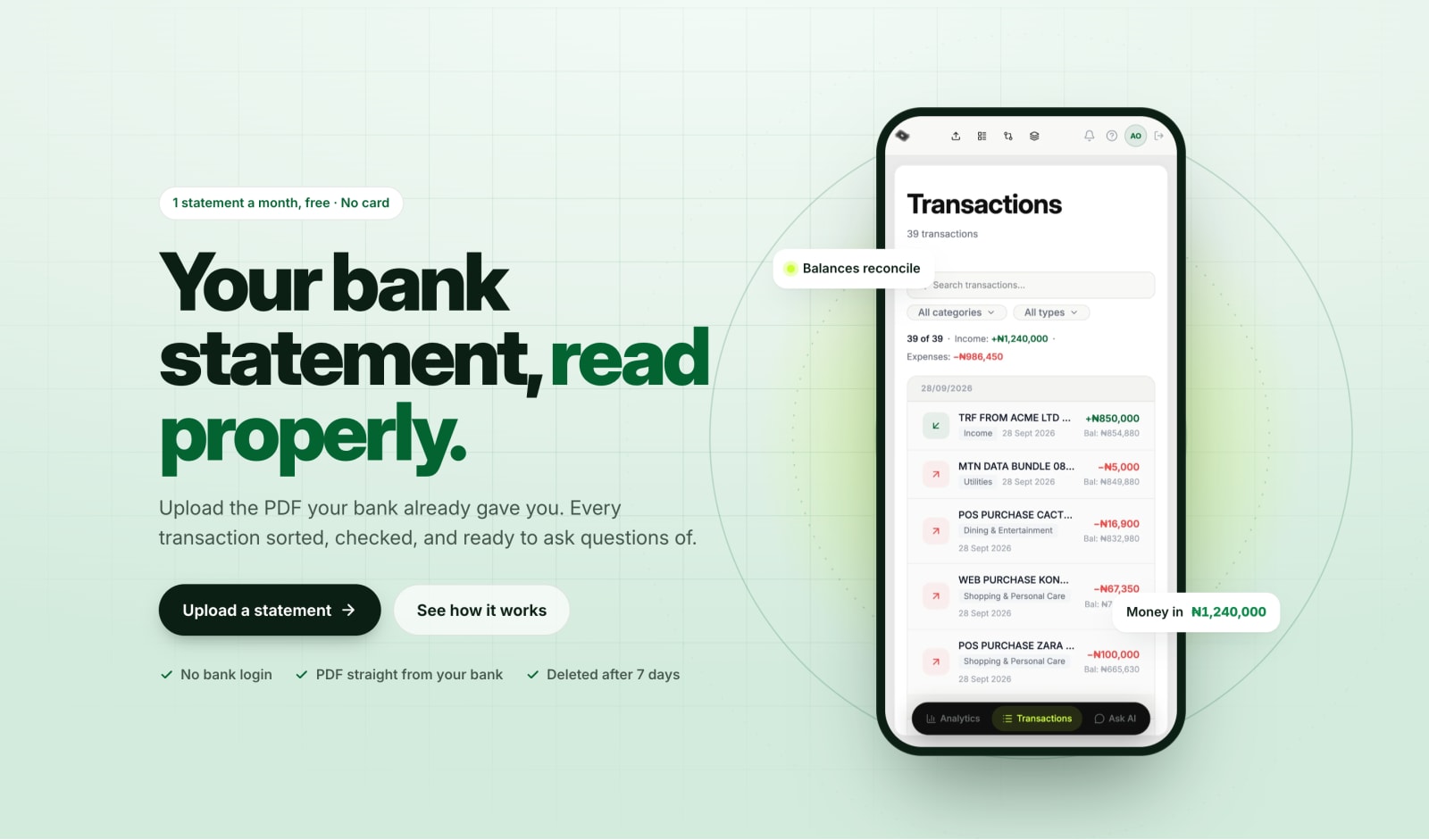
- Nigerian banks it can read
- 14Nigerian banks it can read
- products on one engine
- 3products on one engine
- until a statement auto-deletes
- 7 daysuntil a statement auto-deletes
- bank passwords asked for
- 0bank passwords asked for
What was your part in it?
Thought for 3s
Two roles. As Lead AI Product Engineer I took over an early engine draft from contract engineers and scaled it to read statements from 14 banks into one transaction model, then built the backend and UI that got the product to MVP, the business API and portal, the LLM features, and the open bank-data library. When a technical co-founder joined to run engineering, I became co-founder and creative lead: product design, brand and the whole web experience.
Then · Oct 2025 – Sept 2026
Lead AI Product Engineer. Engine, backend, UI, business API, LLM features, bank library.
Now · Oct 2026 – present
Co-founder & Creative Lead. Product design, brand and the web experience across all three products.
What does the app actually show you?
Thought for 4s
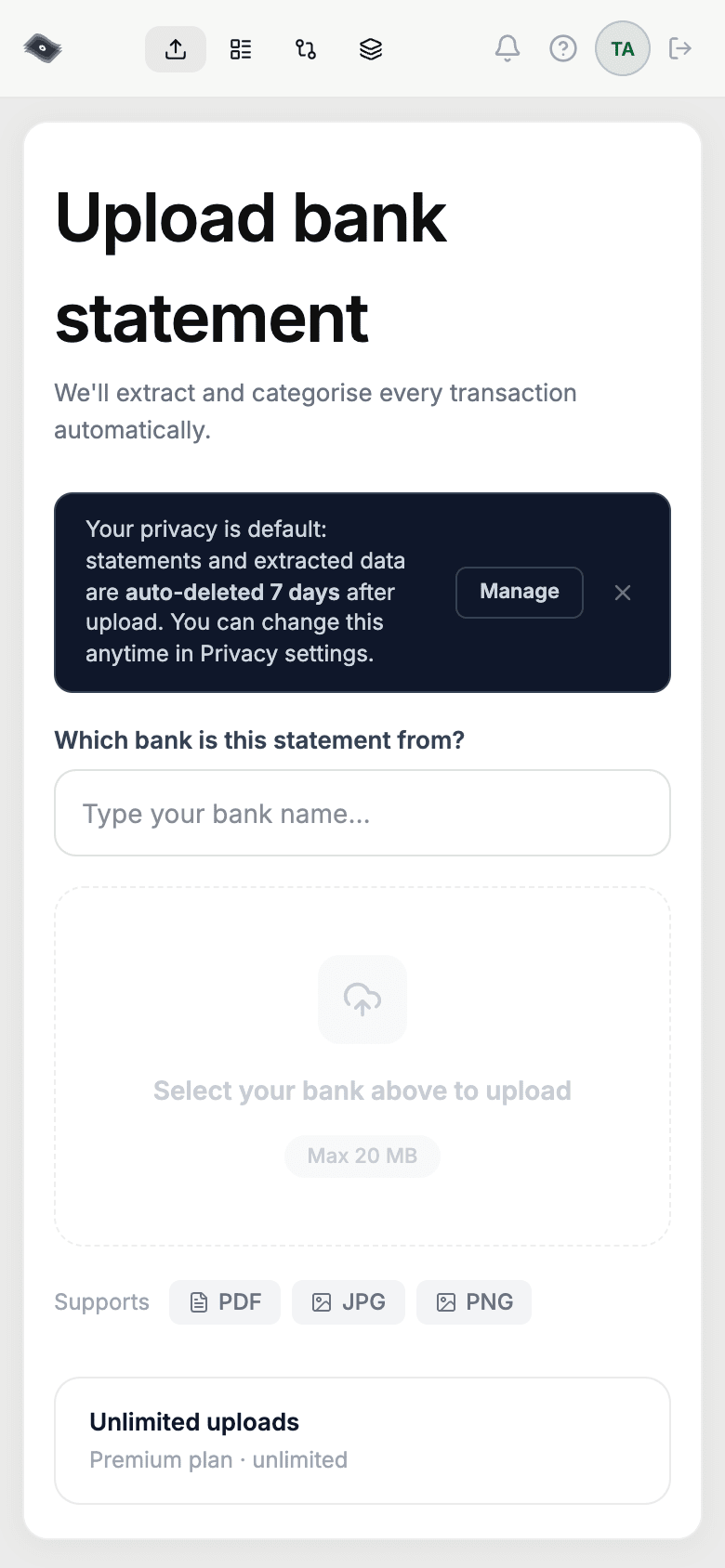
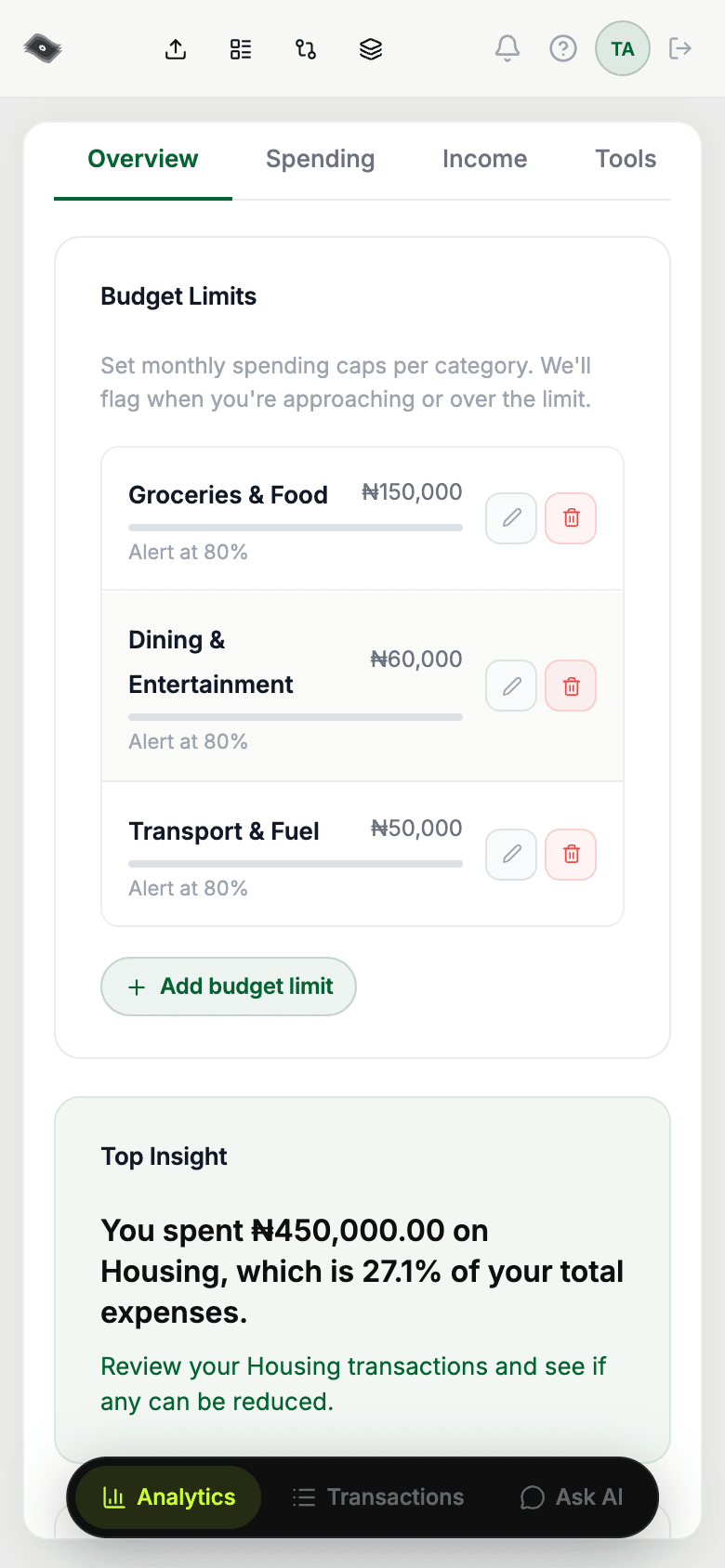
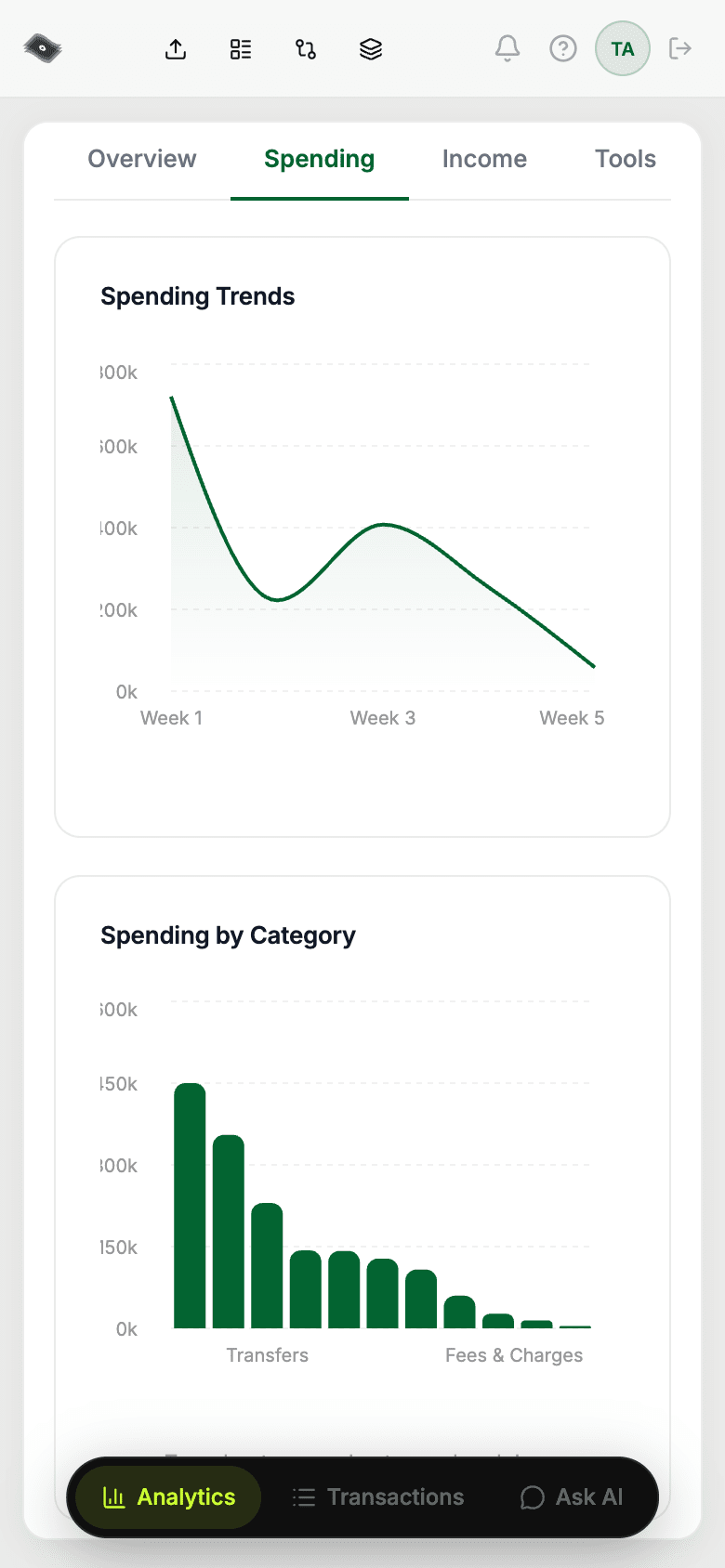
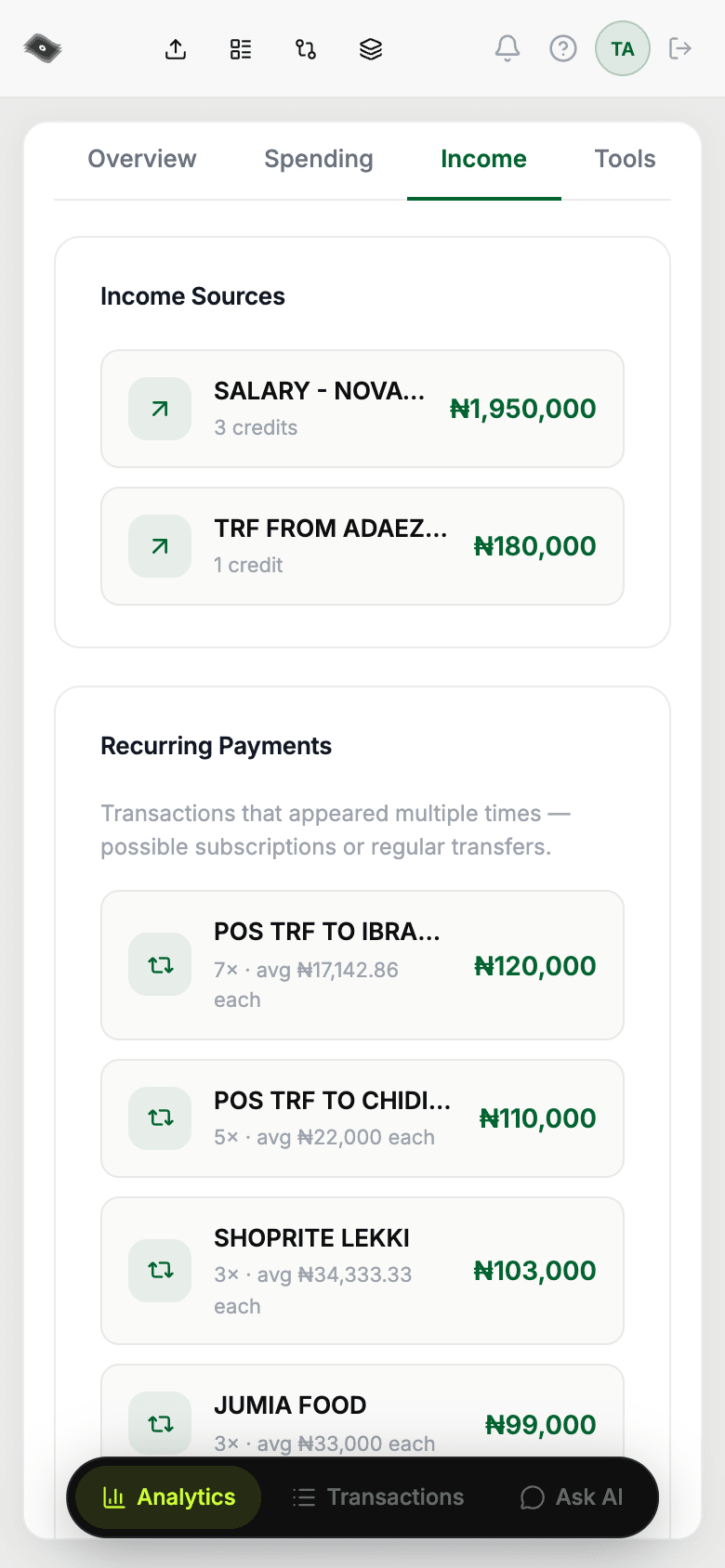
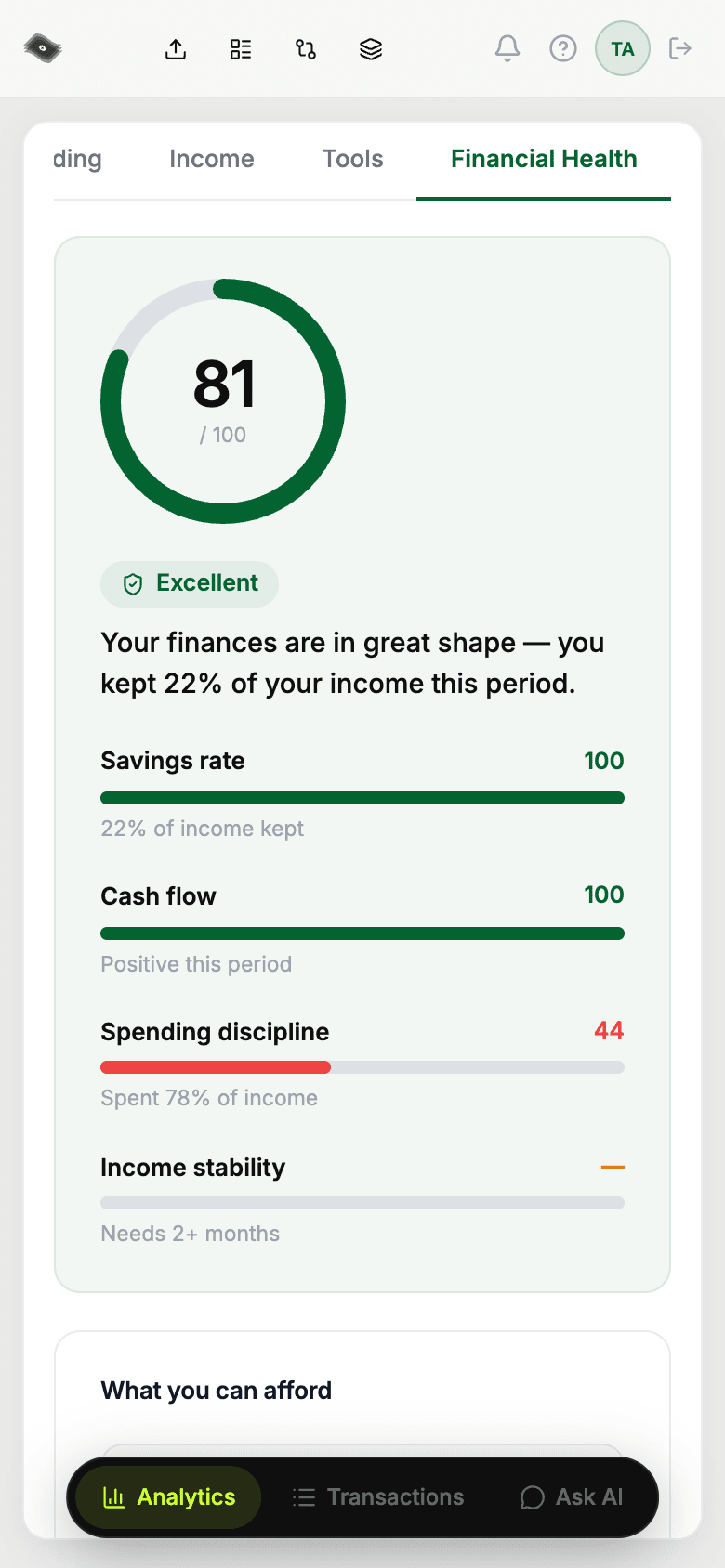
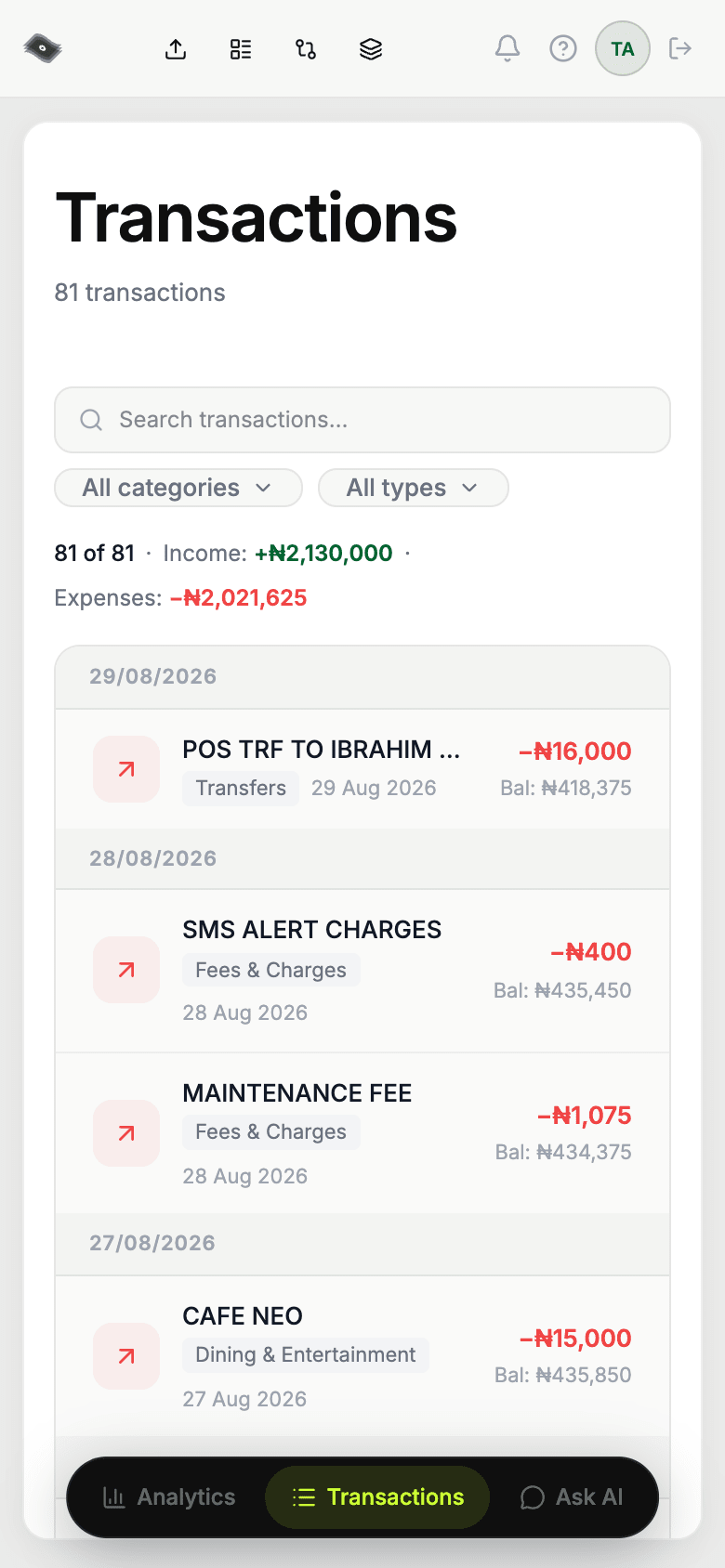
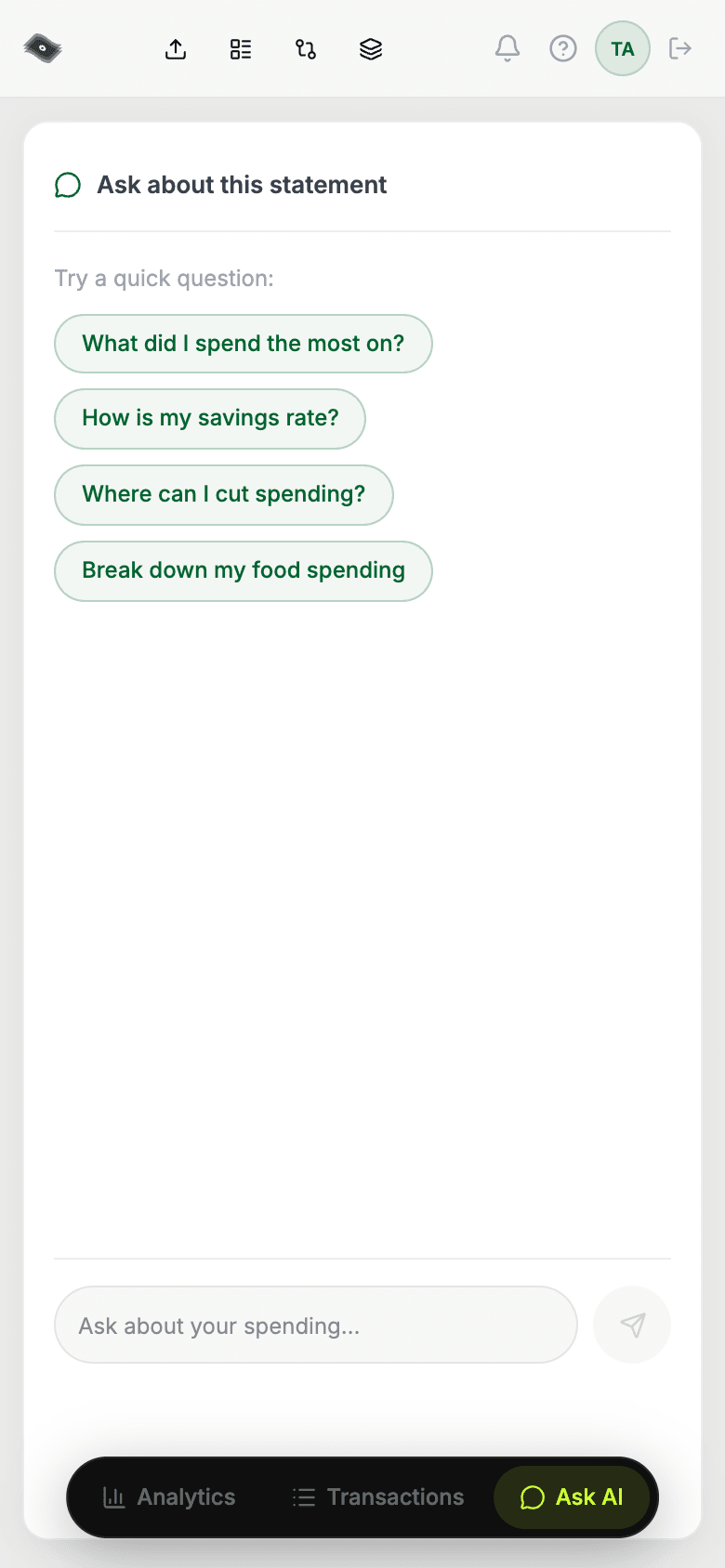
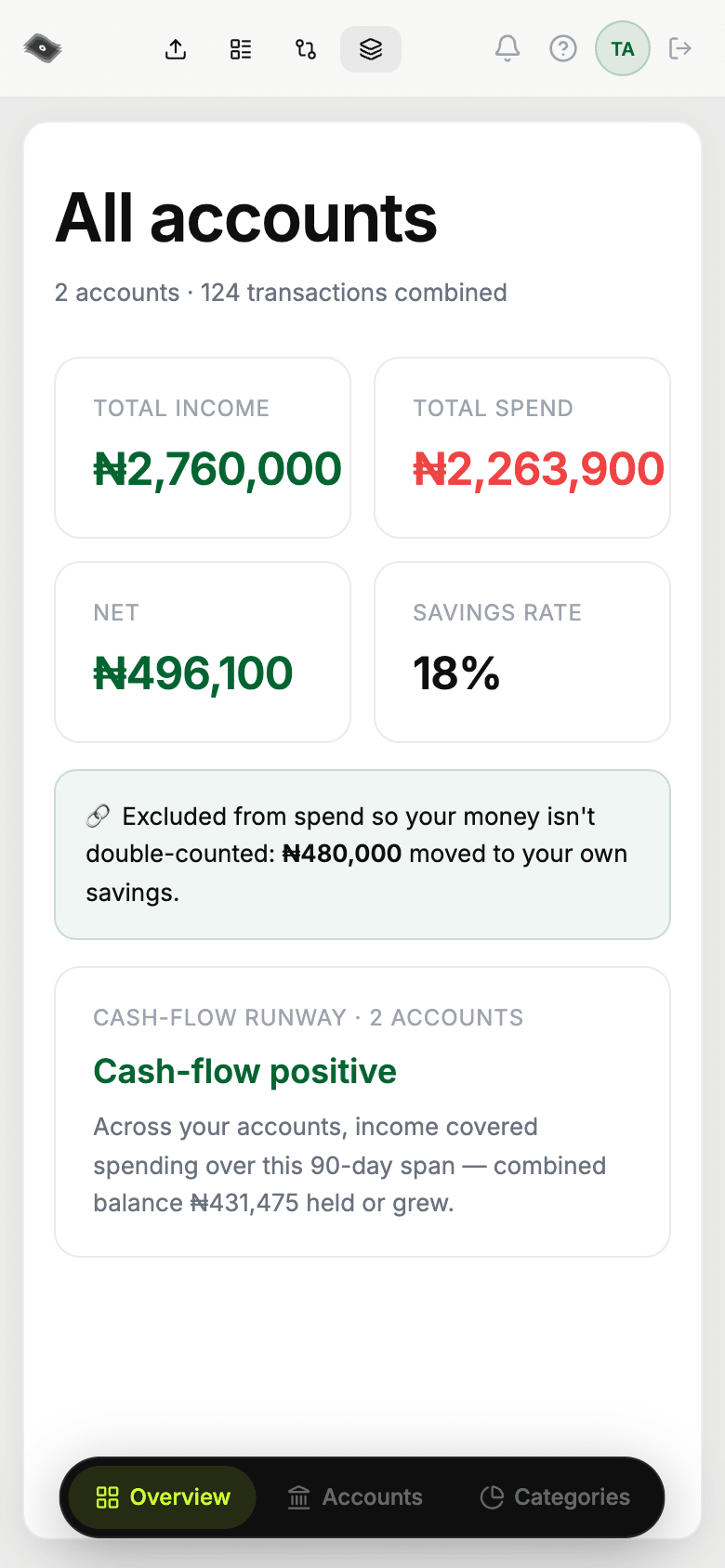
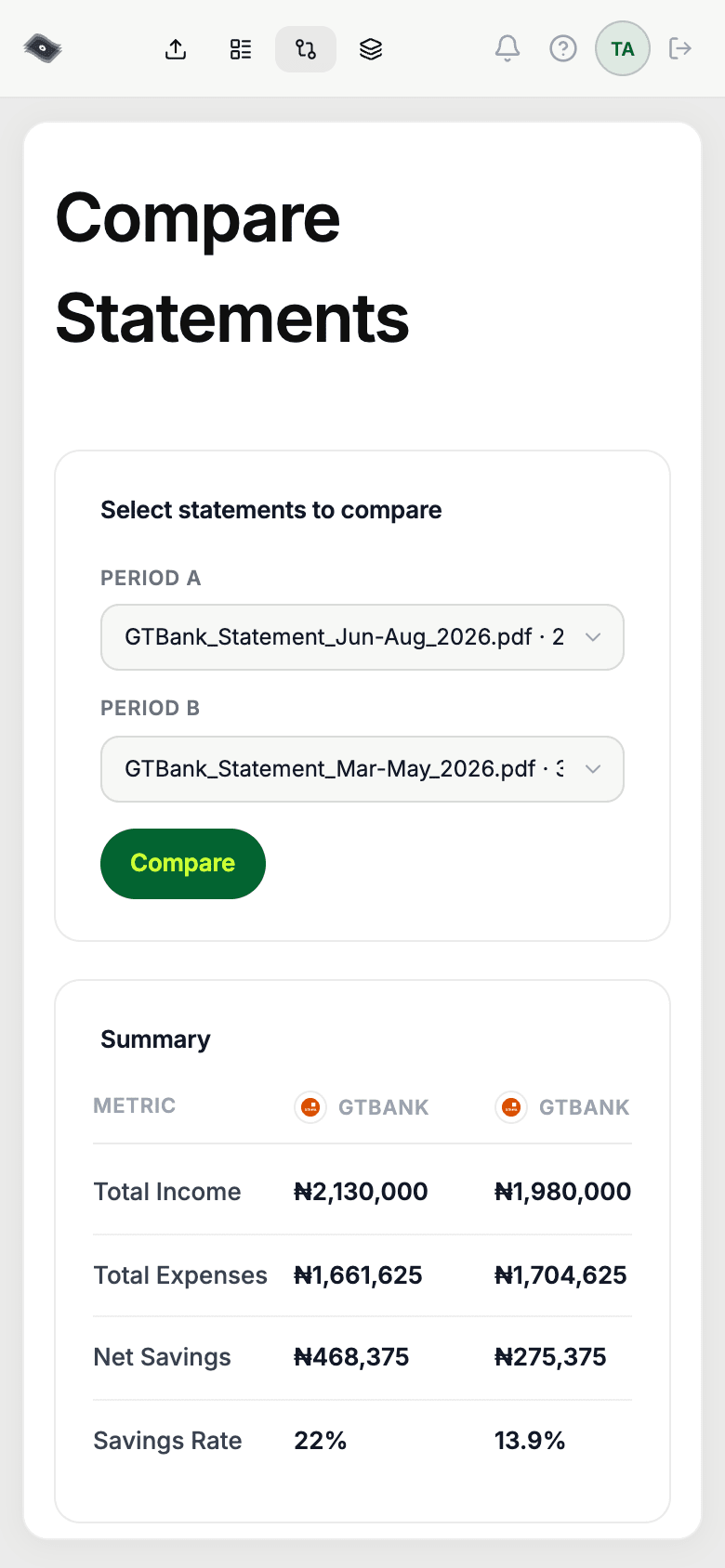
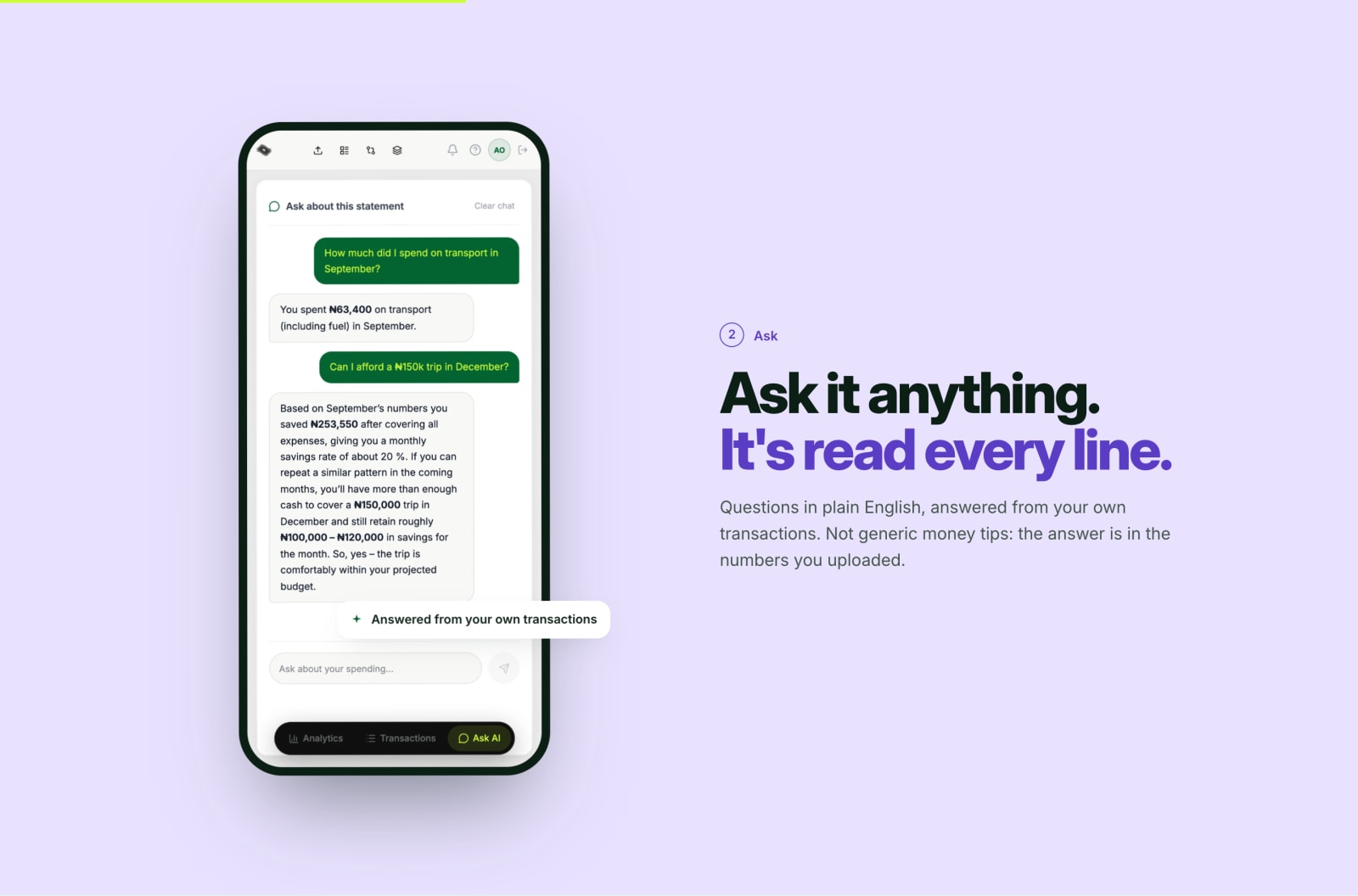
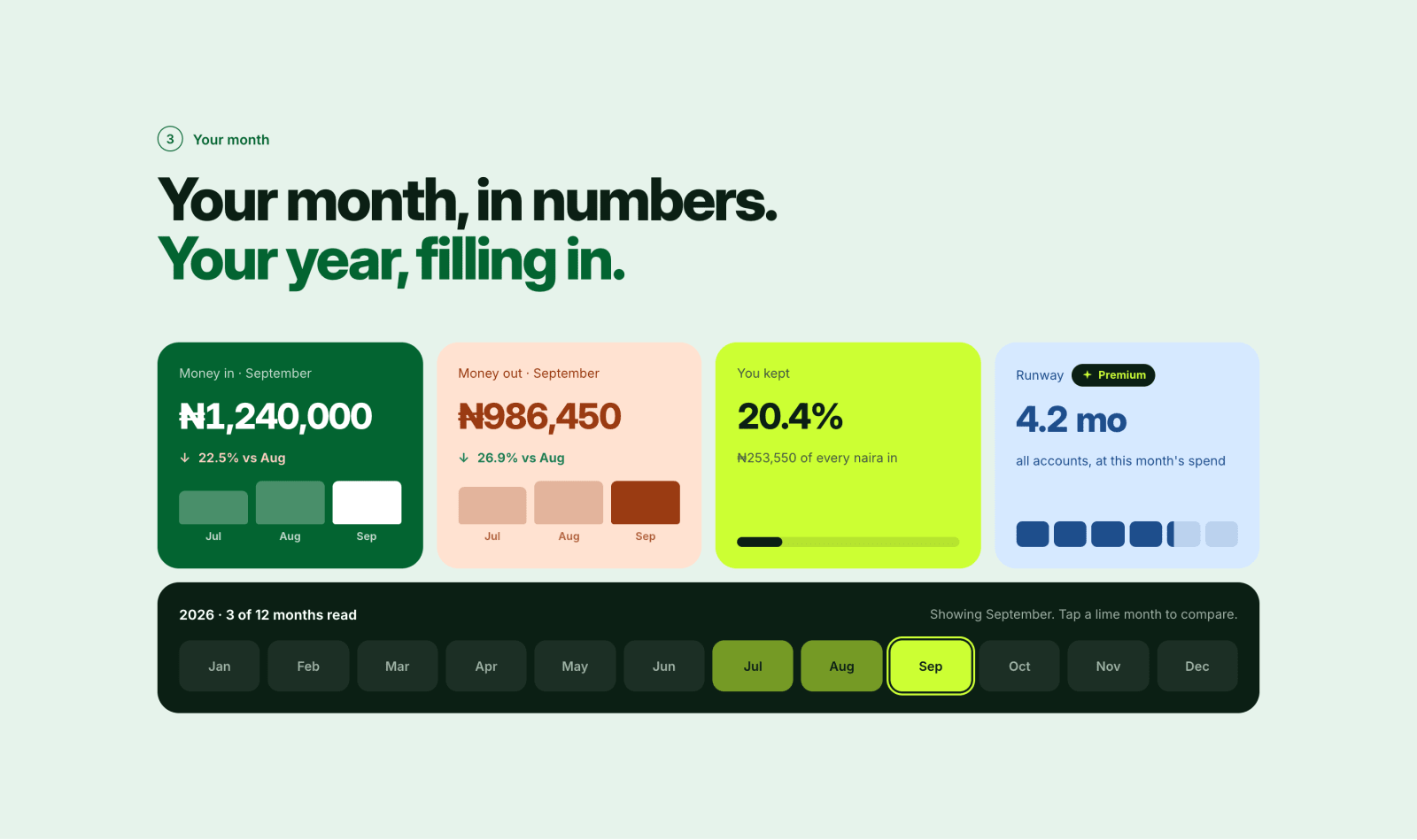
Upload a statement and you land on analytics split into Overview, Spending, Income, Tools and Financial Health, so no single screen tries to say everything. Every transaction is searchable and re-categorisable in place, and Premium adds Ask AI, All Accounts and Compare. These screens use a sample statement for a fictional account, run through the real analytics code.
Why one engine instead of parsing inside each app?
Thought for 2s
Every Nigerian bank formats statements differently: text PDFs, scans, password-protected files, mobile-money layouts. Parsing in each backend would drift. So I made extraction its own product: one private engine that both backends install pinned to the same version, so a bank added once ships everywhere. Tap a step to see what it does.
Works out which of the 14 banks issued the statement, so the right parser runs.
["Works out which of the 14 banks issued the statement, so the right parser runs.","Opens password-protected PDFs with the password the user provides.","Pulls text and tables out of the PDF, with OCR only when the file is a scan.","Turns the bank's own layout into one consistent transaction model.","Sorts every line into one of 15 categories, and learns from users' corrections.","Checks the result against the totals the bank printed on the statement."]ARG ML_TAG=v0.1.30
COPY scripts/install_ml_engine.sh /tmp/install_ml_engine.sh
# Referencing $ML_TAG here makes the tag part of the layer's cache key,
# so a tag bump always rebuilds the ML install.
RUN echo "Installing ML engine ${ML_TAG}" && sh /tmp/install_ml_engine.shShipped3128432 · 2026-07-25
feat(parsers): pdfplumber Palmpay + Stanbic parsers; balance-derived reconciliation
Shipped856cc26 · 2026-08-02
Add Providus / ProvidusUnity support (v0.1.22); fix Providus->UBA misdetection
Support grew from 11 banks to 14, and each new bank reached the consumer app and the business API in the same release.
Explain more
The cache-key comment is there for a reason: without it Docker reused a cached layer and silently kept production on an older engine after a tag bump. One line in the Dockerfile fixed it for good.
How can anyone trust numbers parsed from a PDF?
Thought for 3s
A parser can miss a row at a page break, and a dashboard that quietly under-counts is worse than none: people make money decisions on it. So every statement is checked against its own opening and closing balance, or its printed totals. If it doesn't add up, the product says so. Try it: drop a row and watch what happens.
- 03 AugSalary · Novacore Technologies₦650,000
- 05 AugIKEDC prepaid token−₦25,000
- 09 AugShoprite−₦38,400
- 14 AugTransfer to PiggyVest savings−₦120,000
- 18 AugBolt rides−₦12,600
Illustration with sample numbers. The check is the real one: parsed transactions against the balances the bank printed.
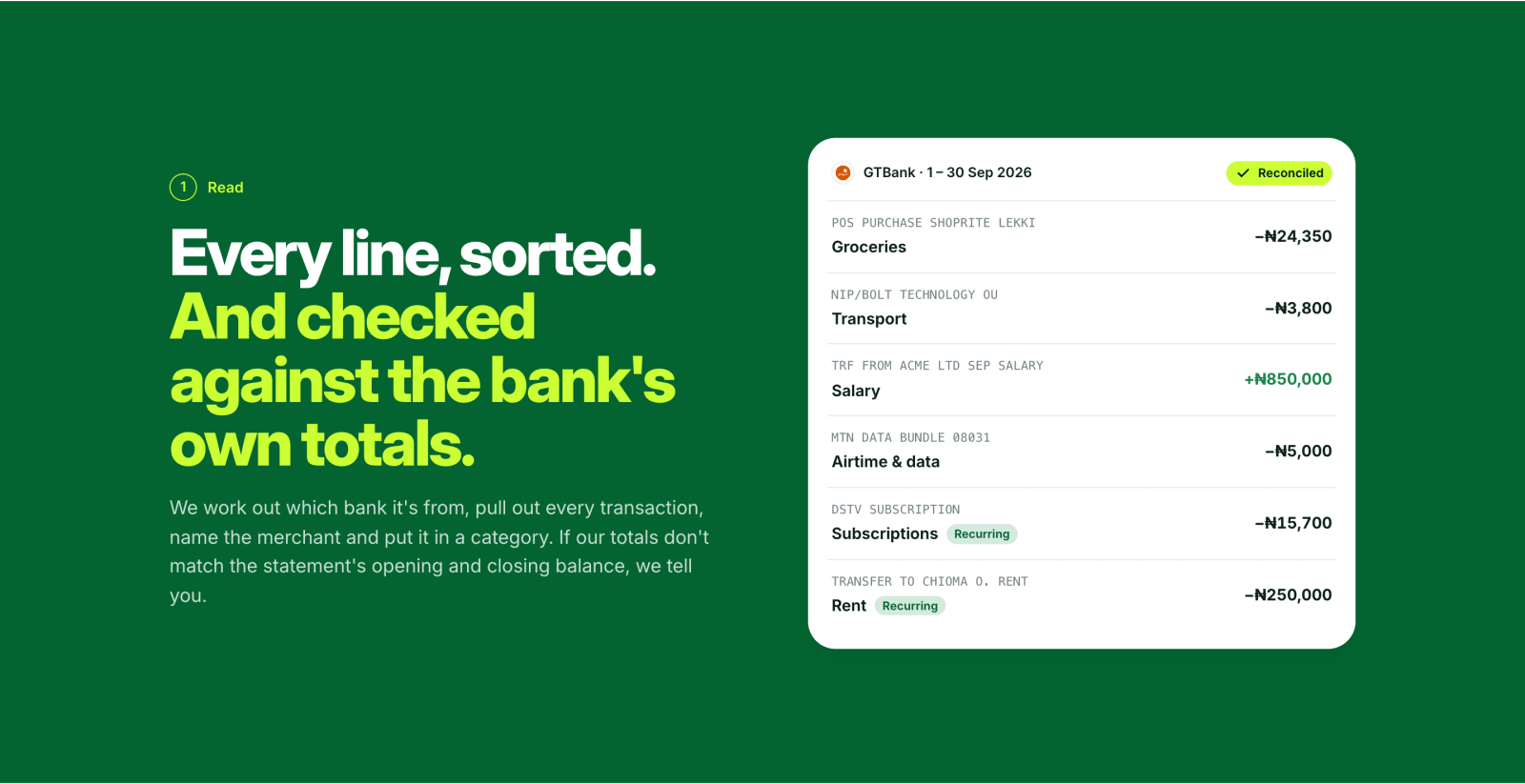
Shipped65f0141 · 2026-07-12
feat(reconciliation): capture-completeness flag + guarded balance recovery
Incomplete extraction is flagged instead of shown as a smaller total. Recovering a single dropped row only runs for banks I'd verified, and only when there's exactly one place it could be.
Explain more
The inserted row's amount is the exact reconciliation gap, so the result reconciles by construction. The guard is what matters: if there's more than one place the row could have dropped from, nothing is inserted and the statement is just flagged.
Is money moved to your own savings spending?
Thought for 4s
On a statement, a transfer to your own savings wallet looks exactly like spending, which makes careful savers look like big spenders. Spendprofile detects those moves and reports them as moved to your own savings, and keeps interest earned as income. The detection is deliberately conservative: a false match would hide real spending. Flip the switch to see the difference.
Reported on its own line, the saving shows up as saving. Sample month.
def is_internal_transfer(txn: dict) -> bool:
    """True if this transaction is a move to the user's own savings/lock,
    not spend or income. 'CashBox Interest' is NOT a transfer."""
    text = ((txn.get("description") or "") + " " + (txn.get("name") or "")).strip()
    if not text:
        return False
    low = text.lower()
    # Interest/dividend on a savings product is genuine income: keep it.
    if "interest" in low or "dividend" in low:
        return False
    return bool(_INTERNAL_PATTERNS.search(low))
The same split runs in analytics, Compare and Ask AI, so the numbers never disagree between screens.
What does a visa officer actually look for?
Thought for 2s
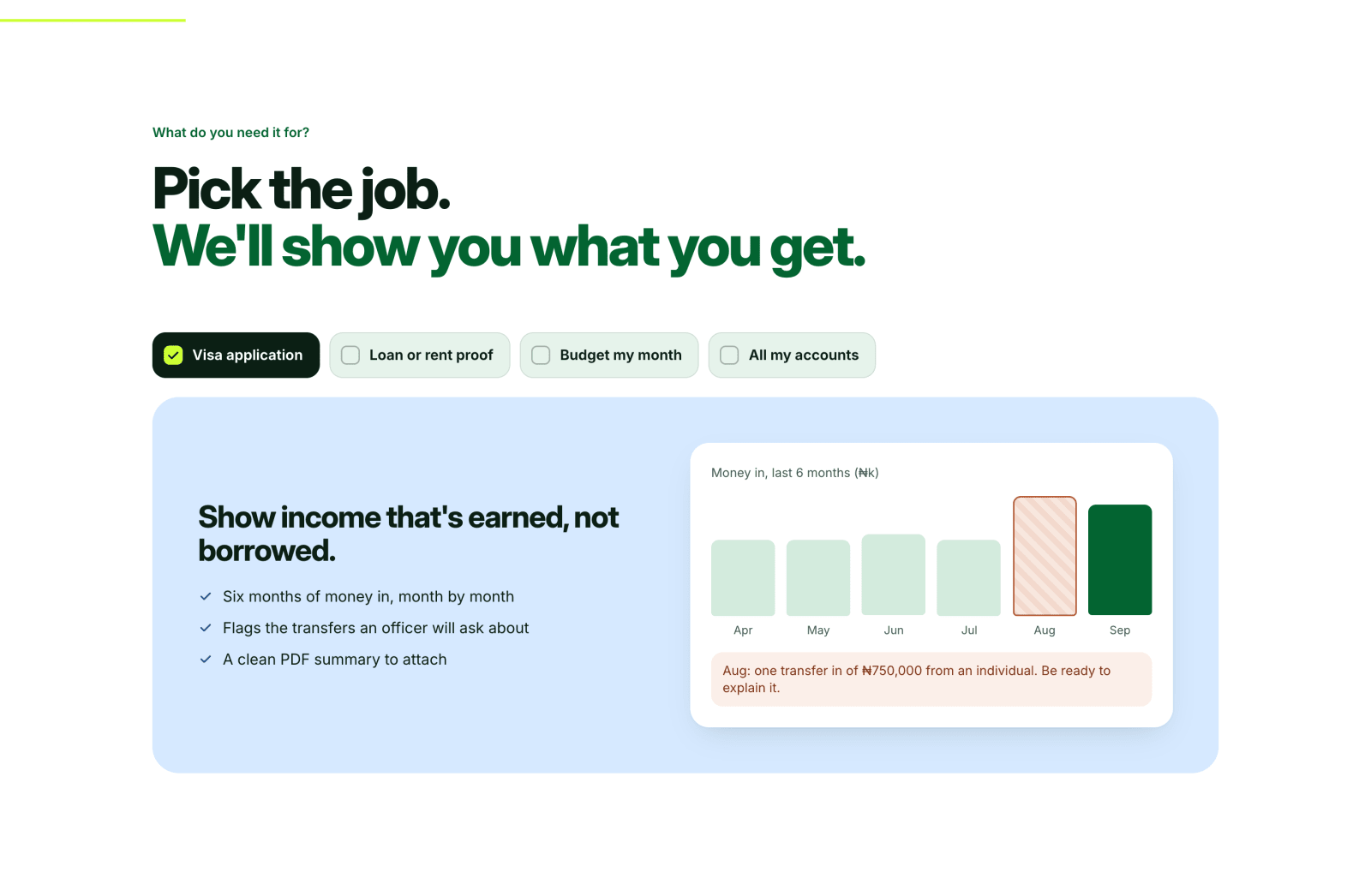
Someone reading a statement for a visa, loan or lease wants income that's earned, not borrowed. A large one-off transfer from a person stands out, and gets questioned. So the analytics now flag the transfers an officer will ask about, with the numbers behind each flag. Move the slider to get a feel for it.
Large, one-off, and a big share of a typical month's money in (₦650,000 in this sample): that's what gets flagged. Illustration only; the product's exact thresholds aren't published.
In the app, with a sample statement.
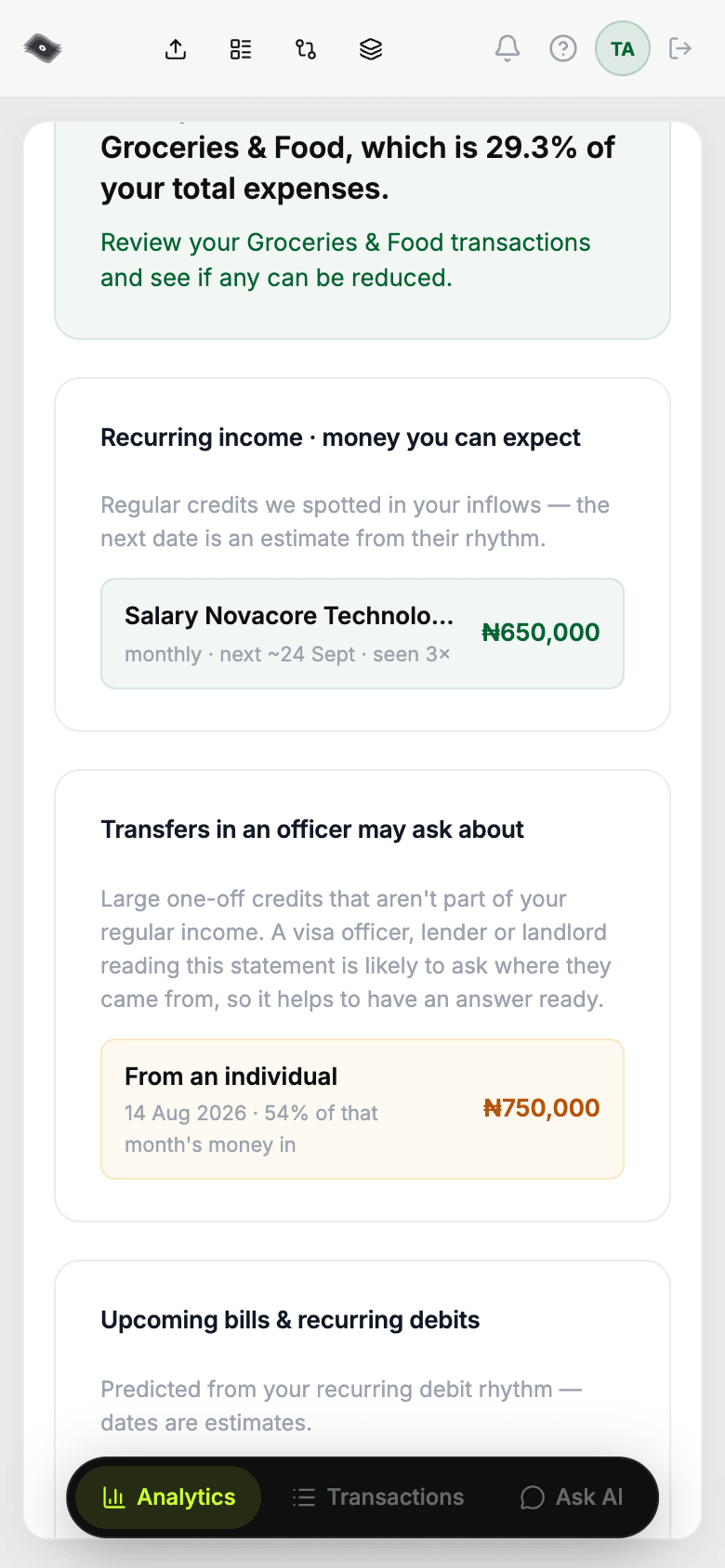
The landing page leads with this job: pick Visa application and it shows income that's earned, not borrowed, and flags the transfers an officer will ask about.
What did you build for businesses?
Thought for 3s
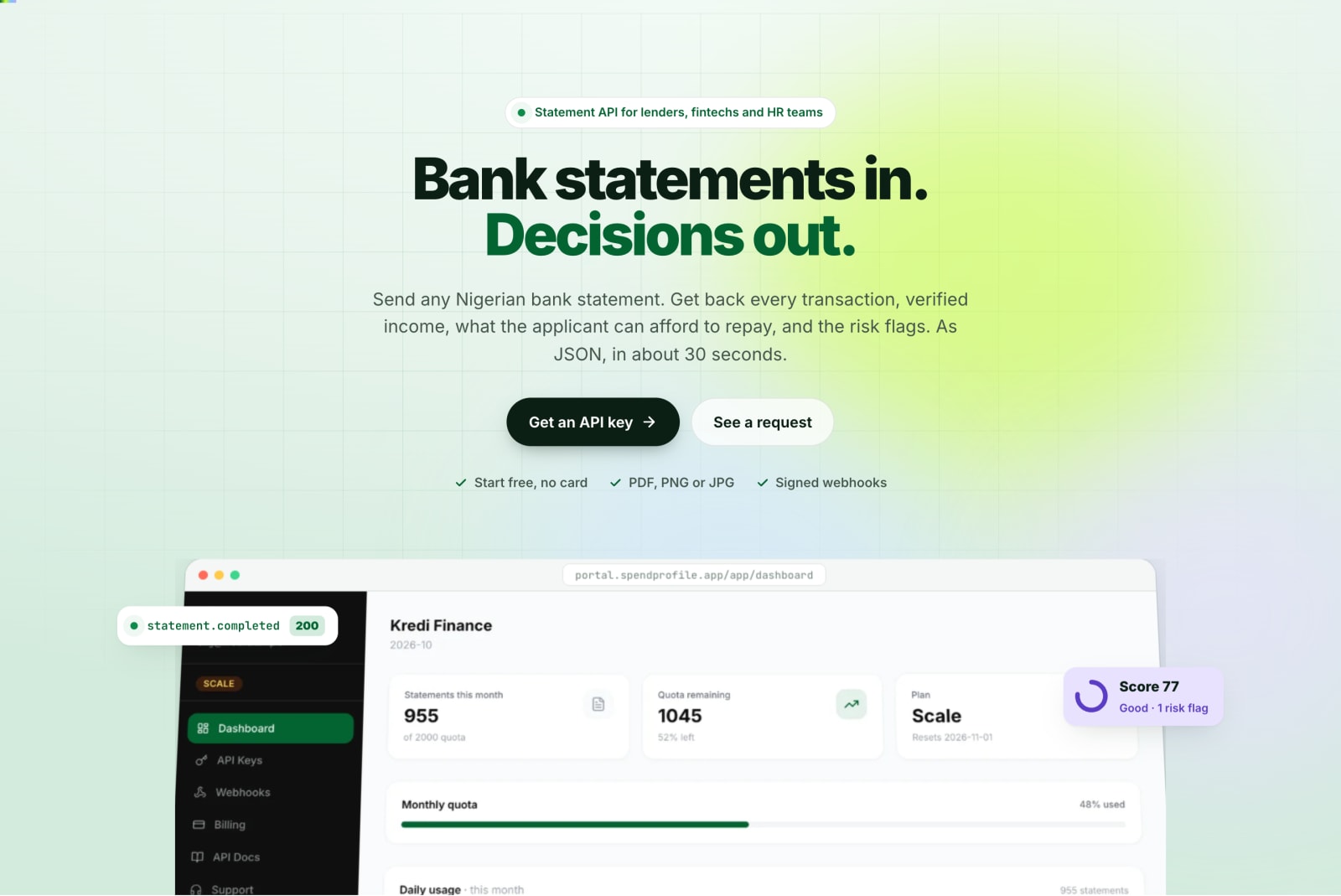
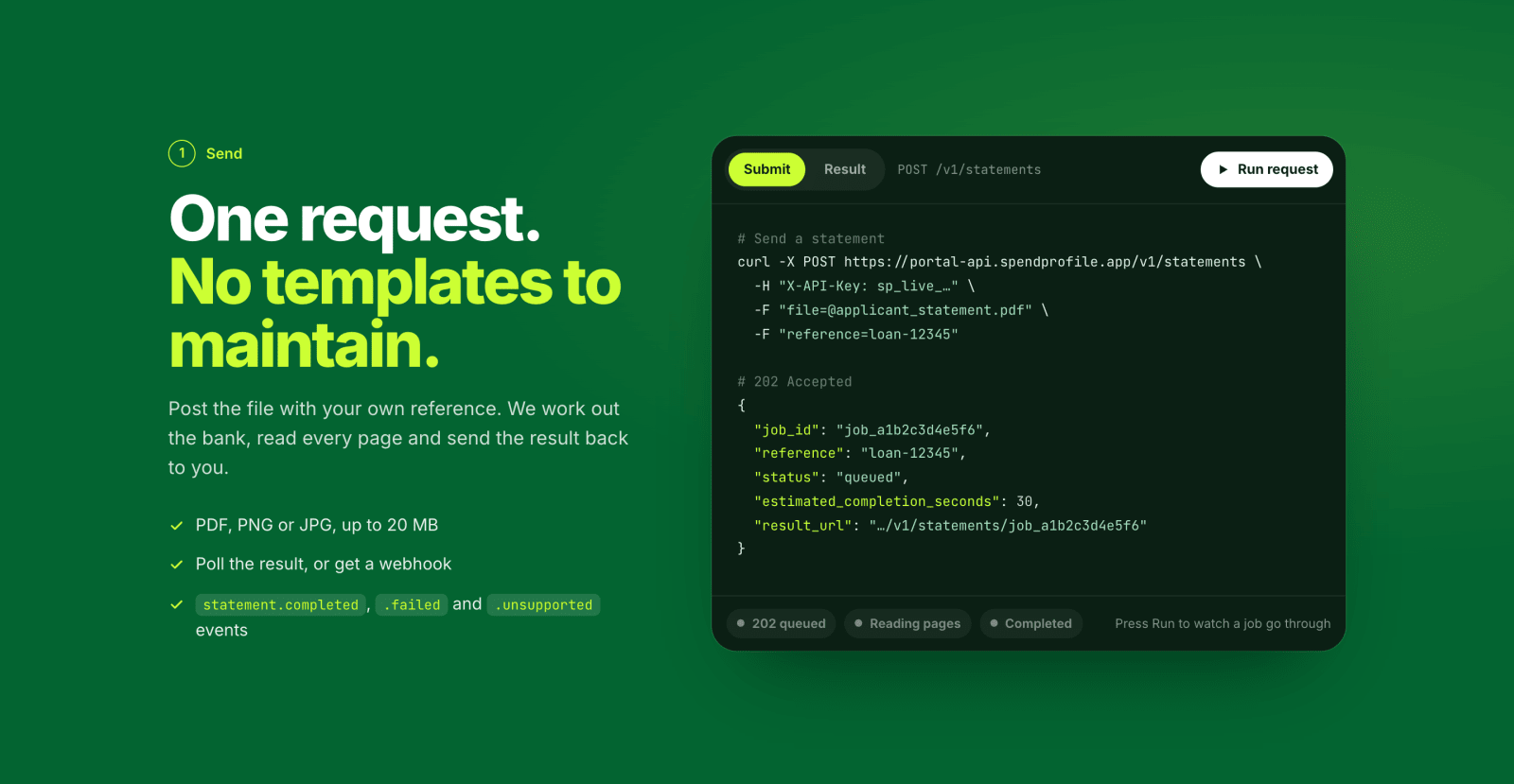
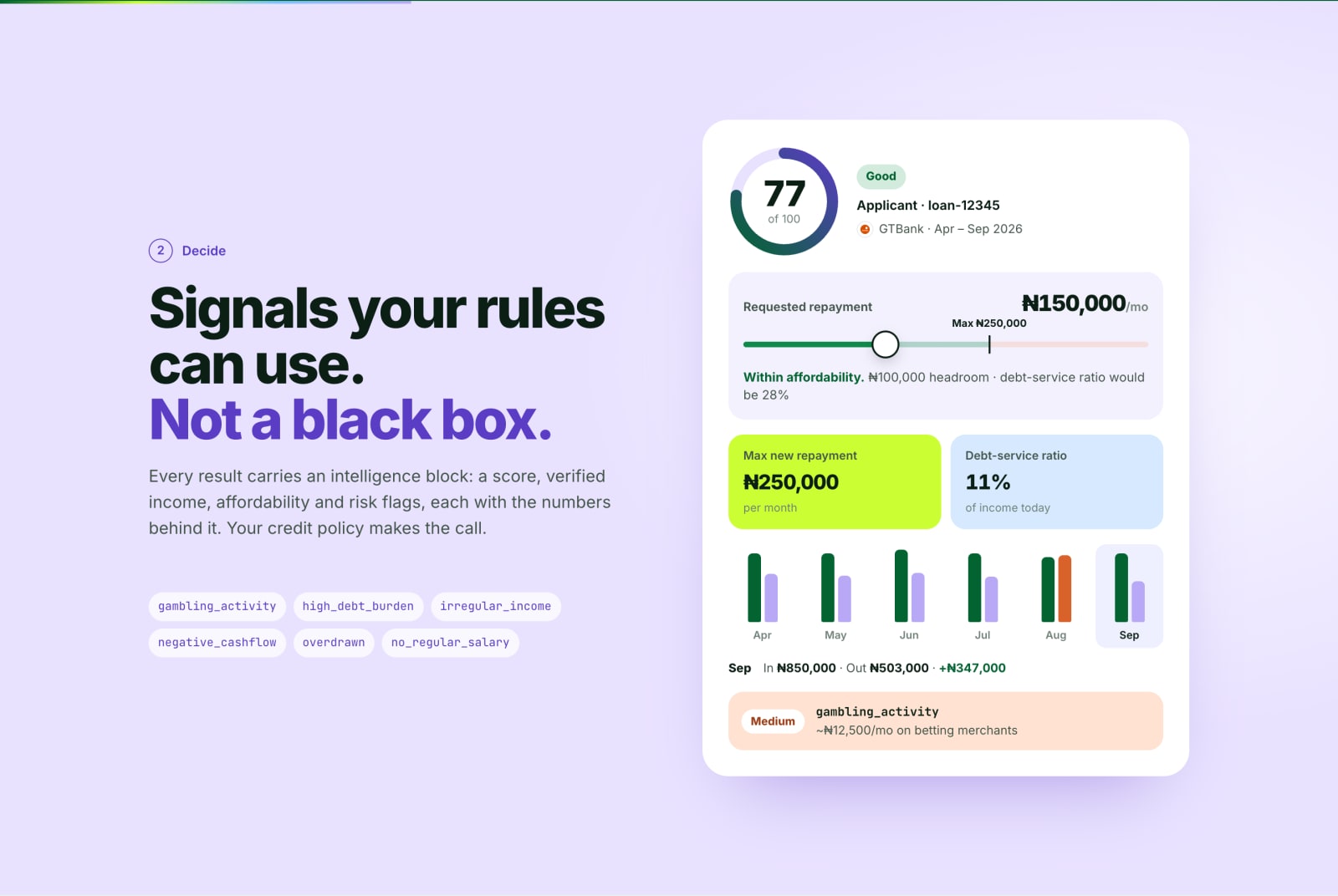
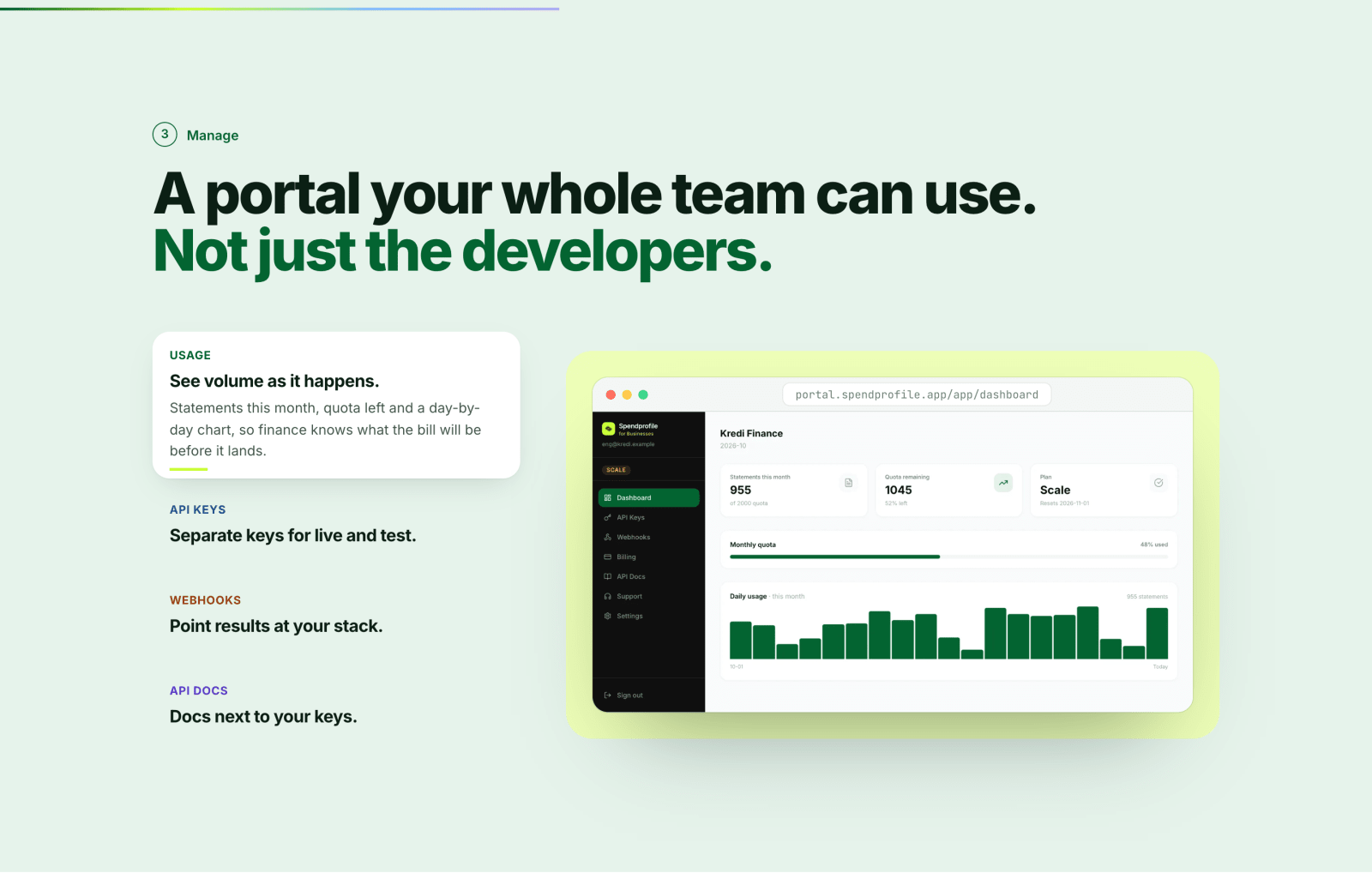
Lenders, HR teams and visa consultants don't want a dashboard, they want one API call: post a statement, get structured JSON back, with income, affordability and risk signals. The portal leads with the request a developer will actually make, then shows the decision block a credit team reads, and keys are scoped, hashed and revocable.
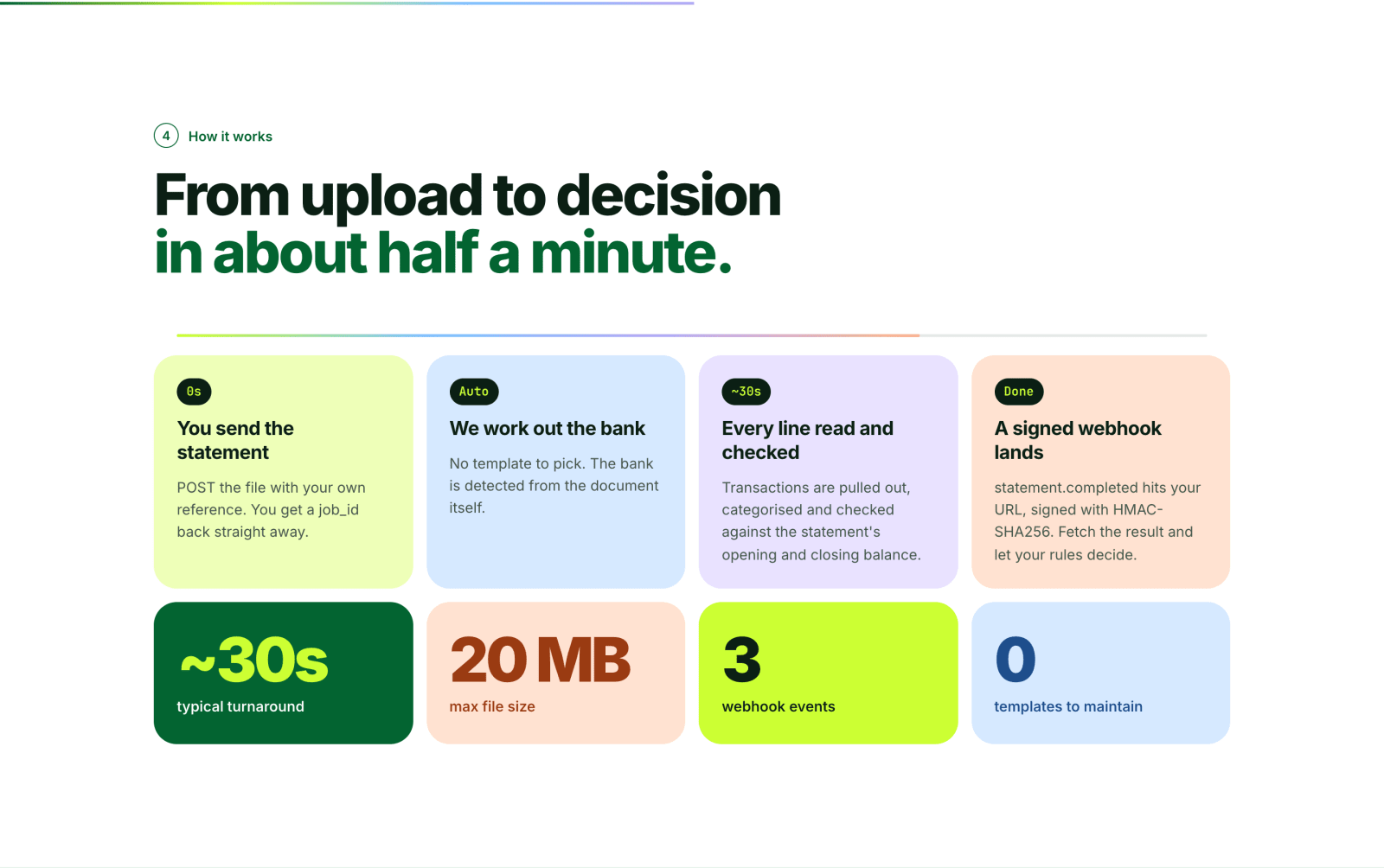

- typical turnaround
- ~30stypical turnaround
- max file size
- 20 MBmax file size
- webhook events
- 3webhook events
- templates to maintain
- 0templates to maintain
What's open source, and what stays private?
Thought for 4s
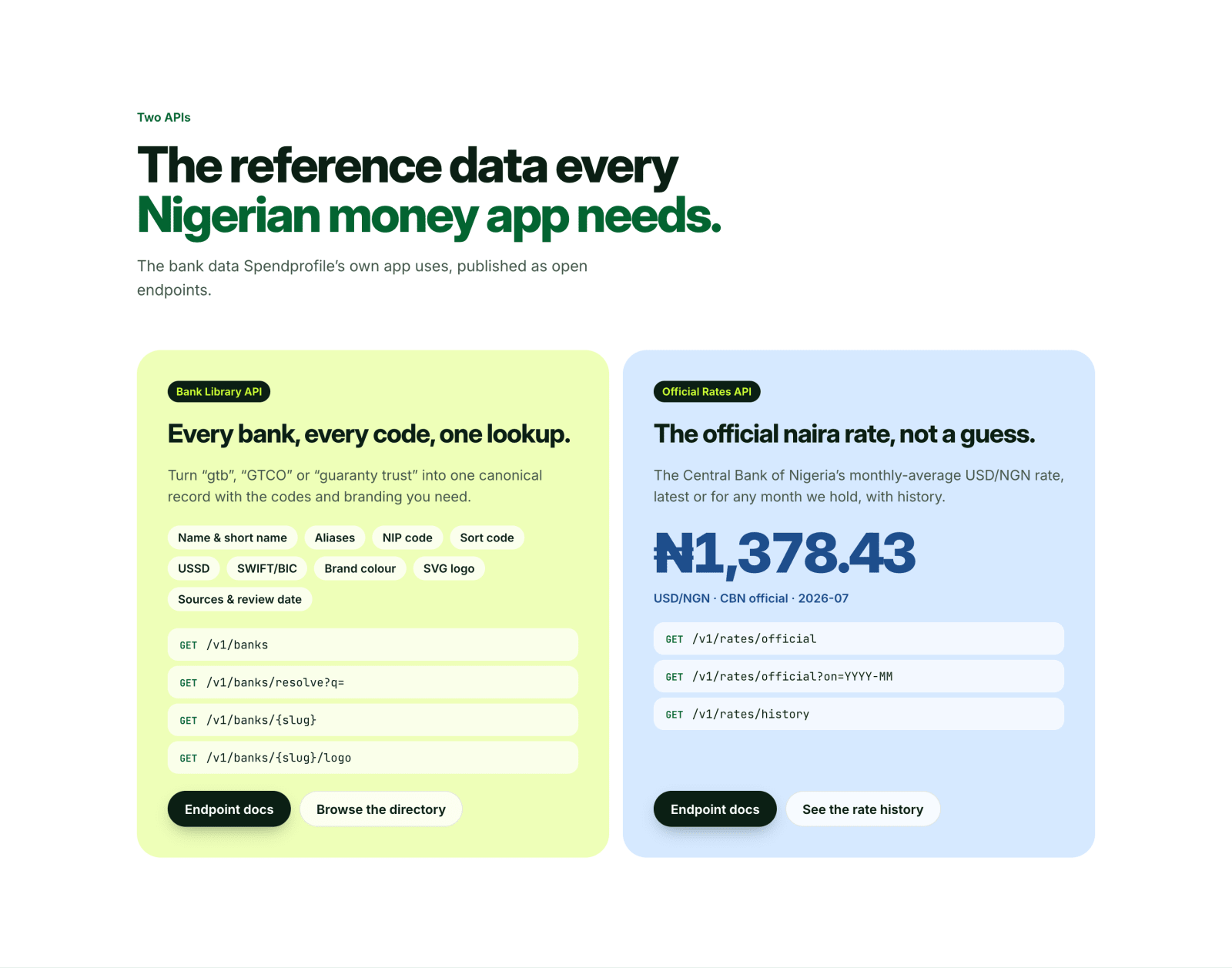
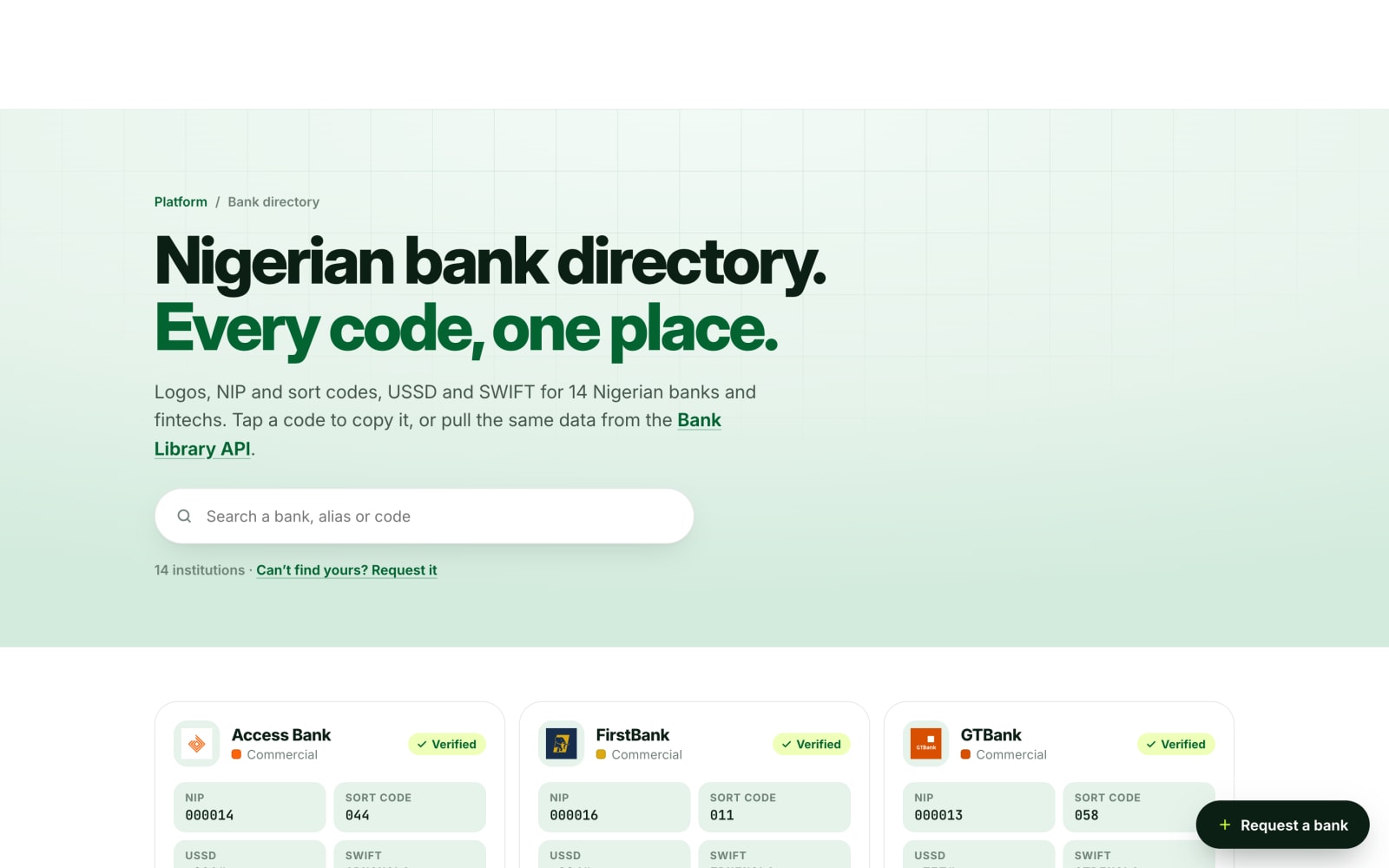
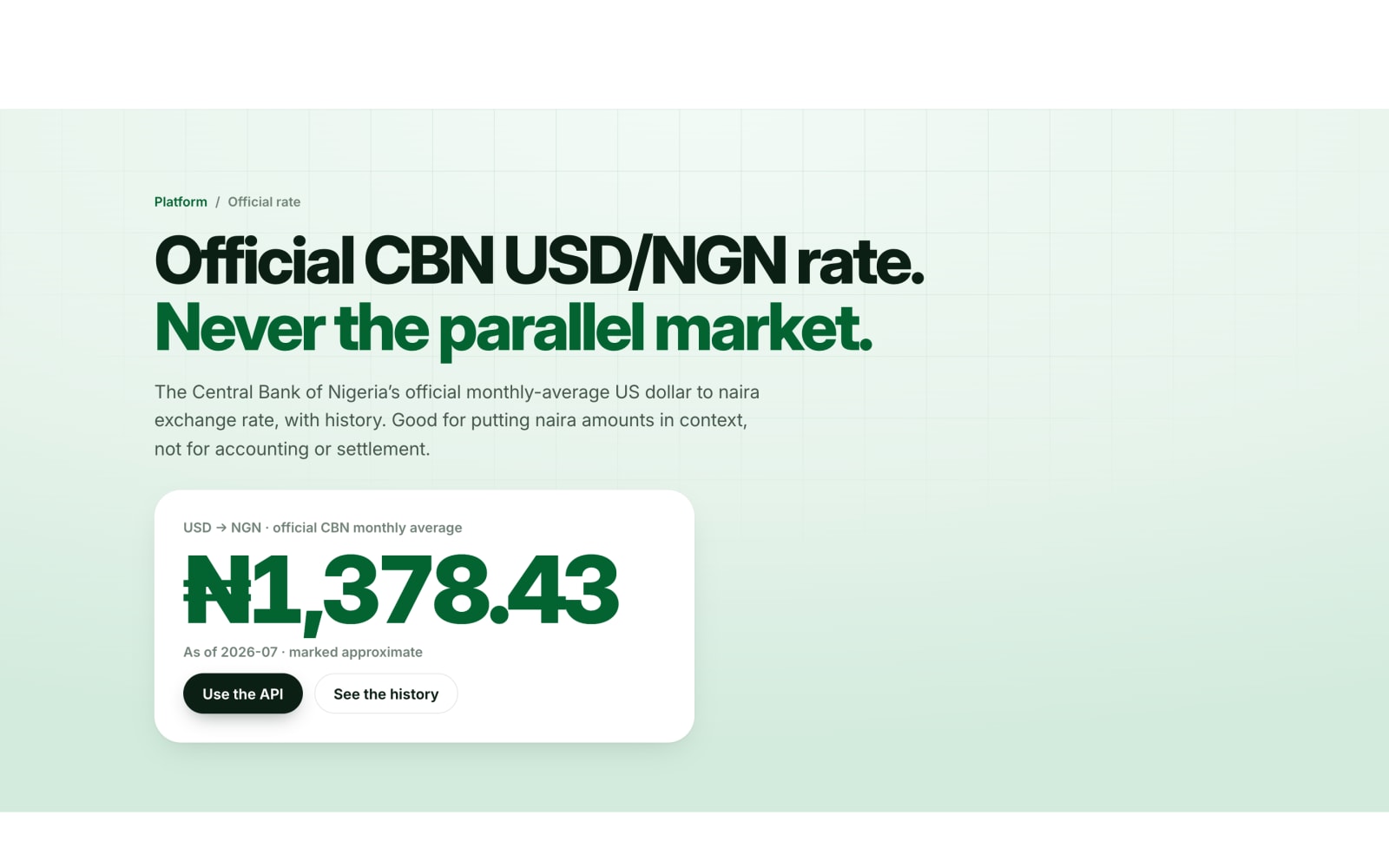
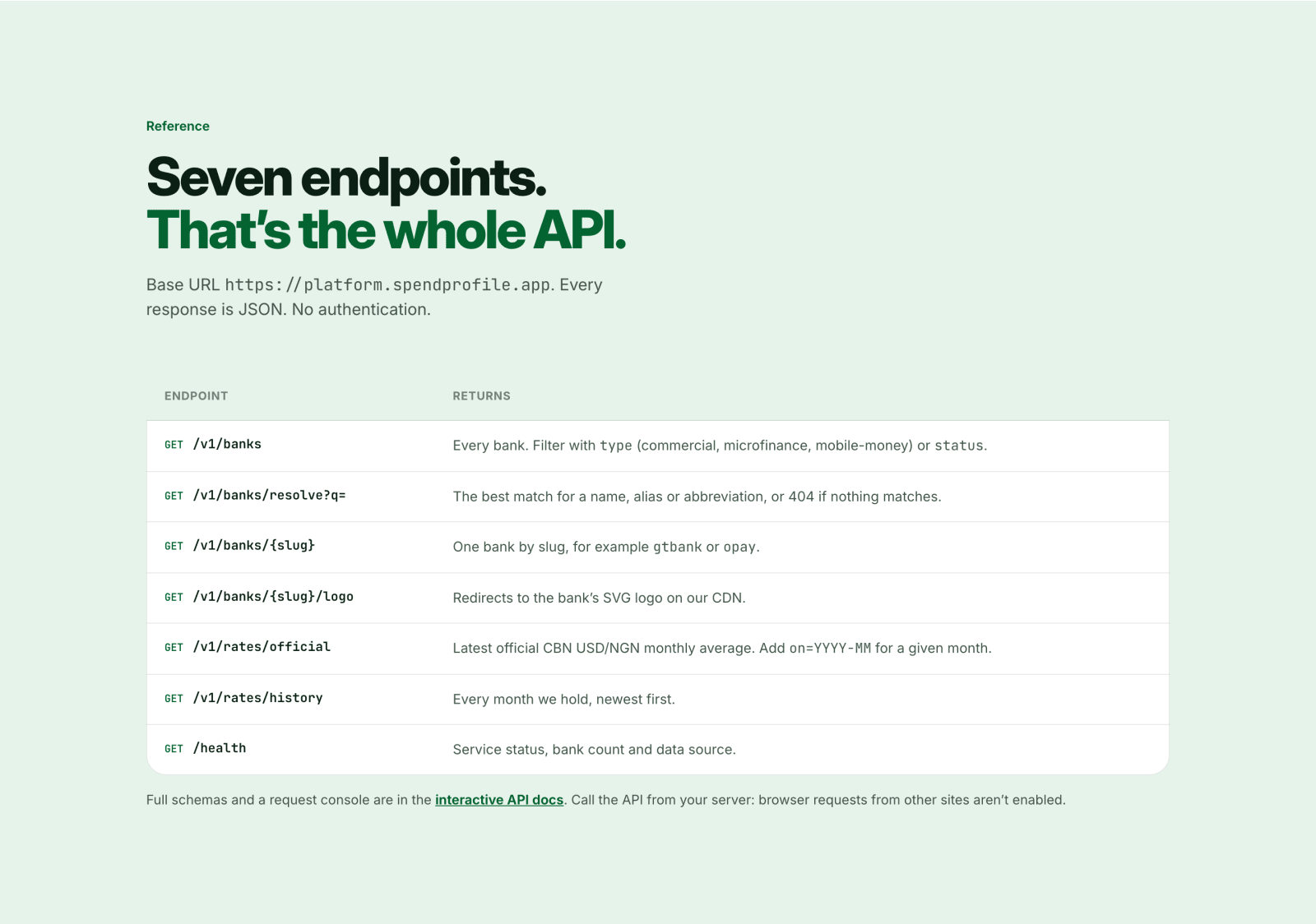
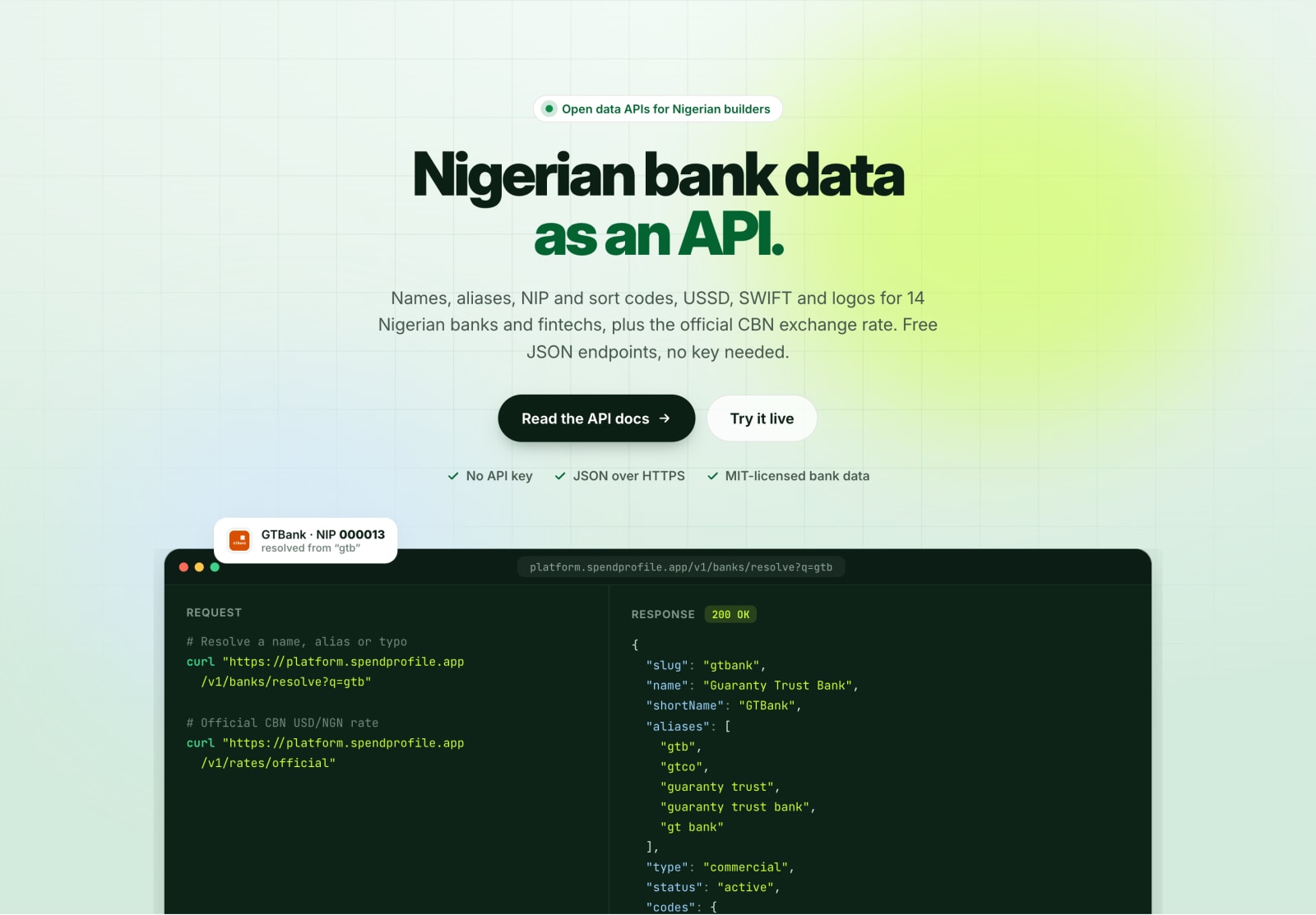
Bank names, routing codes and logos had been copied into four apps and were drifting. That data is useful to every Nigerian fintech, so I pulled it into an open, MIT-licensed library on npm and PyPI, served by a small developer platform with a bank directory and the official CBN rate. The logic that actually reads statements stays private.
{
  "slug": "gtbank",
  "name": "Guaranty Trust Bank",
  "shortName": "GTBank",
  "type": "commercial",
  "codes": {
    "nip": "000013",
    "sortCode": "058",
    "ussd": "*737#",
    "swift": "GTBINGLA",
    "verified": true
  }
}- published on npm and PyPI
- 0.0.3published on npm and PyPI
- endpoints on the platform API
- 7endpoints on the platform API
How private is a statement upload?
Thought for 2s
A statement is about as sensitive as a document gets. Auto-delete after seven days is on by default, and it's stated on the upload screen before you pick a file. Deleting a statement removes the file and the extracted data, the only cookie is the essential sign-in one, and statements used to teach the engine a new bank need explicit consent.
auto_delete_enabled = Column(
    Boolean,
    default=True,
    nullable=False,
    comment="If true, jobs are auto-deleted 7 days after creation (default on)"
)
You redesigned the web experience. What changed?
Thought for 3s
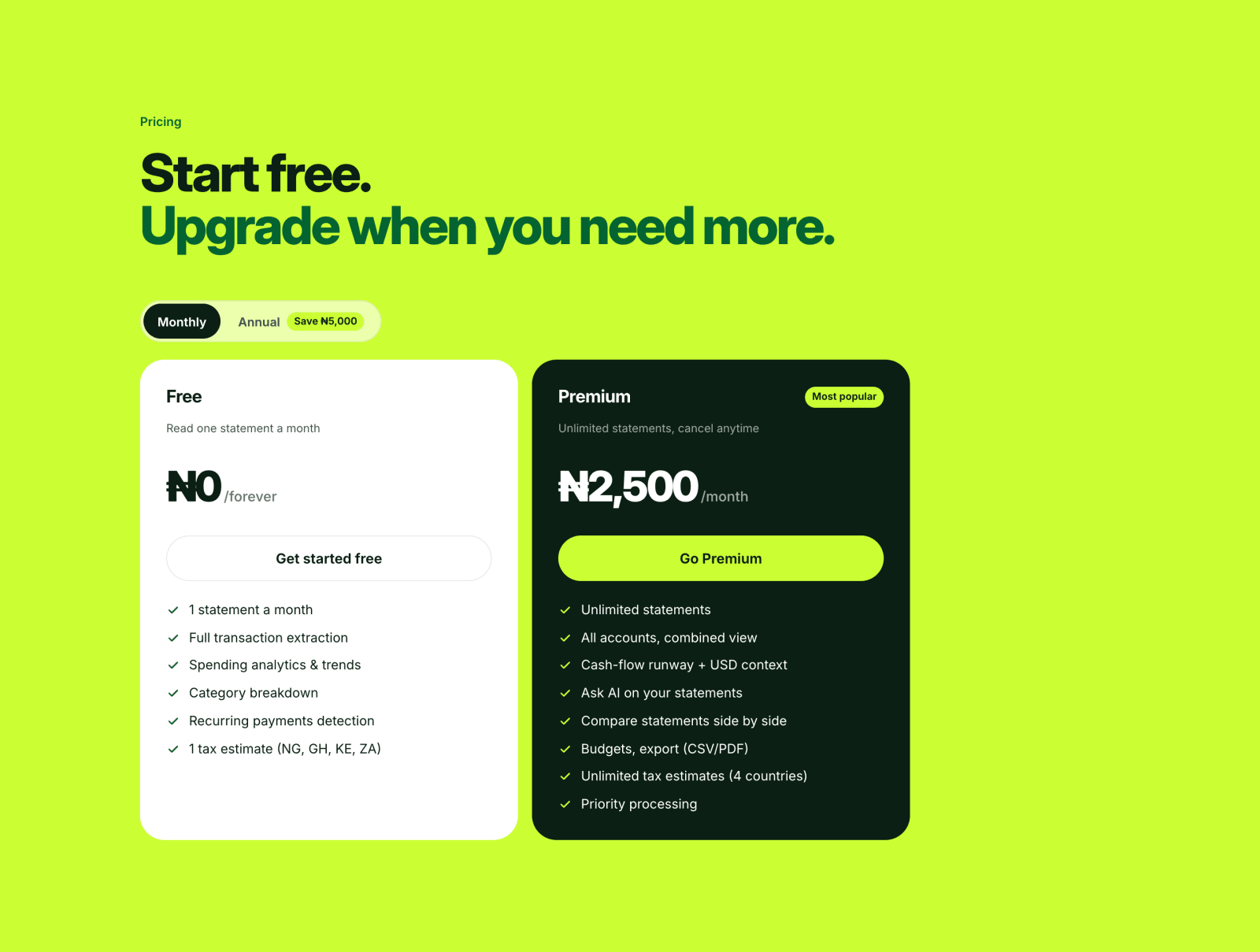
The three products had drifted apart visually. I redesigned all three into one visual world with an audience switch for Individual, Business and Platform, built around the jobs people actually have, like a visa application, rent proof or a monthly budget, and around the product's real screens and honesty: no bank login, deleted after seven days, totals checked.
If you started over tomorrow, what would you do differently?
Thought for 4s
I'd build the engine before any interface, earlier and on purpose. Everything since, from the business API to the developer platform, was cheap because extraction was already its own product.
- Engine firstTreat extraction as the product from day one.
- Admit uncertaintyBetter to say a statement may be incomplete than be confidently wrong about someone's money.
- One source for the brandFour copies of one palette was invisible until it wasn't.
- Know what to give awayOpen data built goodwill; private detection kept the product defensible.
Thinking
The scripted part of this conversation carries the verified facts. Live answers only use what's on this site.